Category Archives: News

China big winner of the League of Legends World Cup, the biggest esports event in the world.

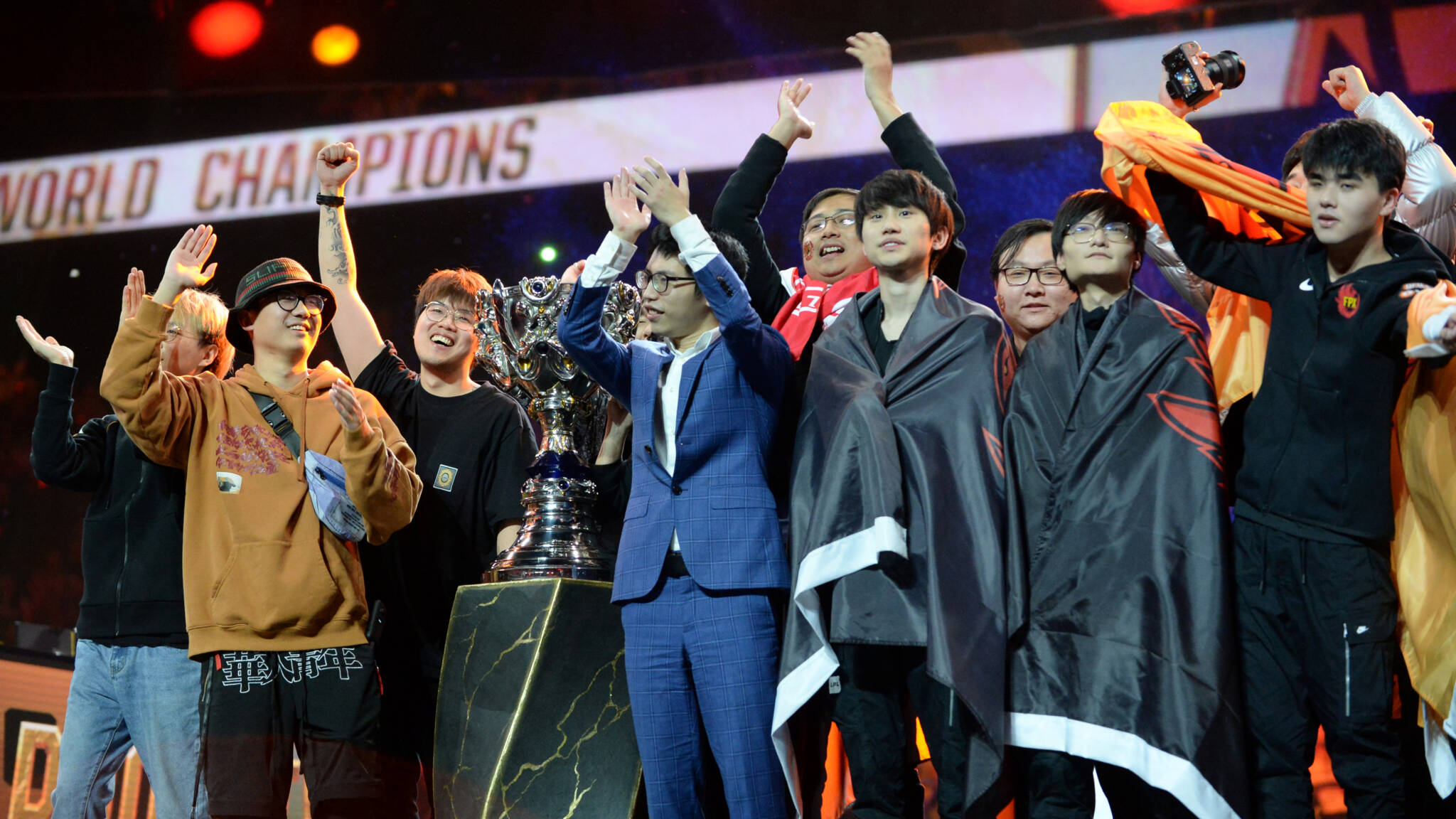
League of Legends winners

The Chinese team FunPlus Phoenix has just won the final of the world championship of the video game League of Legends. More than 100 million people are expected to have watched the live stream of the final match. The match was played in a packed arena with spectators.

The Chinese won 3-0 against the European team G2 Esports. Not entirely a surprise, say the experts.

"The hope was that the European team would win, but actually that was against our better judgement. The level of the Chinese teams is just that little bit higher," says Ward Geene of the website Esports Club. "The competition in that region is very strong. A lot of talent is being developed there. For a long time, South Korea was at the top, for example."

The final of the League of Legends World Championships is the biggest event in the world of esports in terms of viewers. Last year, 99.6 million people watched the final via the livestream. The Chinese team Invictus Gaming won. In comparison: the Super Bowl - the final of the American football season - was watched by 114.5 million people last year.

Geene expects that with this afternoon's final a new ratings record has been set. "League of Legends has been the biggest game in esports for years and in terms of viewing figures it hasn't reached its peak yet. There was a European and a Chinese team in the final again this year, so both in Europe and in China a huge number of people will have been watching."

FunPlus Phoenix gets to share a few million euros after winning this afternoon. The team also receives a trophy with an accompanying case, specially made by the French luxury brand Louis Vuitton.

Source: Nos.nl

Esports: Top sport with a keyboard


Source: Volkskrant
Anyone who has had anything to do with gaming lately will know that Fortnite is a worldwide phenomenon. The game, in which 100 men on a virtual island fight until only one remains, has proven time and again to be a huge success. For the very best players, gaming is not a frivolous pastime, but top-class sport with a corresponding income. Dave 'Rojo' Jong (21), the most successful esports player in the Netherlands, is well on his way to his second million.

Dave gets out of bed around noon. The top athlete lives on American time. And as befits a top athlete, he starts each day with a protein- and fibre-rich breakfast: oatmeal and hard-boiled eggs. A bite to eat, an hour of fitness, and then it's time for the workout. Dave likes to make comparisons with professional football, a future that the athlete also considered when he played meritoriously at the youth team of football club Hollandia in Hoorn. Training three times a week, and matches against the youth teams of Excelsior and Ajax.

It's like holding the high ground,' says Dave, taking a seat in the game room next to his bedroom, where an ultra-fast computer hums softly to control his equipment: three widescreen monitors, two keyboards, two cameras, a radio microphone and a mixing desk. 'If you practise that for a few minutes a day, you won't be as good at it as if you were doing it for a few hours a day.'

Fortnite: Build, Shoot, and Set Traps

And just like a professional footballer, training starts with a warm-up. In his case: shaking off the wrists, warming up the fingers, awakening the ability to react. Making Nineties, that is, building structures with ninety-degree angles - floor-slope-walls, floor-slope-walls - at lightning speed to propel your character upwards and above an opponent. He practices on long gangways with walls to the right or left, to move as bullets come from the side, and on platforms to shelter from overhead fire.
But then, through a crack in the door, Mother Mary, just silently appeared on the landing. Dave, do you have time for dinner? Asked a little later if it's not time for her wealthy son to hire a catering service, while Dave puts his fork in a steaming casserole of chicken-potato-french beans, she smiles. I like doing it. When he was still playing a lot of football I had to drive him around and I had a lot more work to do.'
When the chicken is finished, it's time for shooting practice. Red spheres and bars dart across the screen along random paths in a programme called KovaaK's Aim Trainer. Dave has to click on them with the mouse as quickly as possible. There is no embellishment, no beautifully designed game world; KovaaK's is the digital equivalent of a vending machine that shoots endless balls at a tennis player - but with a new ball every second. Training my hand-eye coordination,' says Dave.
Training, training, and training again. E-sportsmen call it 'grinding': making metres to become even faster, even sharper, and even more successful. To shave off a fraction of a second of your reaction time to a specific tactic of the opponent. The margins are small, in top sport, also in esports. Dave studies the recordings of his lost games minutely, like a football coach dissects the replay of a failed attack from second to second.
Suddenly, a target shoots vertically in an arc across his crosshairs, the cross indicating where he is aiming. Pats, hit. A situation like that almost never happens in Fortnite, but I train for hours on it,' says Dave. Only one player in a championship final will jump over you like that. A hit or miss is the difference between zero and a prize of a ton or so.
At Kovaak's, which is deadly boring, Dave trains for an hour and a half to two hours. Every day. Fortnite is about responsiveness, but also about tactics, communication and cooperation; Dave can shoot well, of course, but shooting games are not his speciality. So he has hired Croatian gamer Serious, a top Quake shooter, for 60 dollars a session to coach him. Serious prescribes exercises, discusses his progress in reaction time and accuracy with Dave every two weeks via Skype, and adjusts the training schedule accordingly.
KovaaK's is followed by six to eight hours of Fortnite training every day, in a select company of top global players who are a match for each other. Dave doesn't learn much from playing against ordinary mortals; he makes them up in no time. Sometimes he does it just for fun, a 'public' game. He usually wins, too, against 99 other players. Occasionally, though, someone manages to shoot Dave dead. He chuckles. Sometimes I see them writing on Twitter a little later: 'Wow I just won from Rojo!

Full agenda

Dave's schedule is unfortunately full; he has no room for further commitments at the moment," read the email from Jane Tesar, Communications and Brand Manager on behalf of Team Lazarus, just after their Dutch recruit had gambled away his $1.1 million last summer. Suddenly Rojo was a celebrity in the gaming world, and in the real world David was surrounded by a hedge of managers and PR people.
These have since faded into the background, after the madness of the World Cup subsided, but for Dave, life has changed forever. Not so long ago, he was an ordinary boy from an ordinary family, living in an ordinary village, and like many other boys his age, often gaming. Until he finished high school in 2016, a gap year followed, and another gap year, and he gradually spent more and more time in front of the computer. 'My mother didn't agree,' he laughs. ''Is he now upstairs gaming again?" the neighbours sometimes said.''
top sport with a keyboard
In early 2018, he discovered Fortnite, which had been out for six months. Dave actually wanted to play another video game, but didn't want to lose the 30 euros it cost. So he threw himself into Fortnite; it was free. Fortnite has a system of amateurs, semi-pros and top players. Dave turned out to be a natural. He shot his way to the top level within a year and in 2019, he and his then teammate and 169 other gamers qualified for the World Cup in New York.
'Then we tweeted: hey we are still looking for an organisation. You can email us or send us a message on Twitter,' he says in his usual slightly flat tone, as if explaining how the washing machine works. 'Hold on,' he says, leaning towards the microphone and addressing a teammate in English. 'Yo Savage, they've got us listed against Ewroon, later. No idea who that is. Huh-huh-huh.' He continues: 'Well, and then Lazarus responded and he offered a certain amount and then I asked for a higher amount and they agreed.' Dave does not want to reveal the exact amount in the newspaper, but his salary is well above average.

Top-class sport or pastime?

Gaming seven days a week, 365 days a year, eight to ten hours a day. Add to that the trips to tournaments in the US or Sweden, the attendance at gaming events that his employer Team Lazarus expects of him, and you could say it is a tough job. But Dave also does it for fun. Although, if he didn't get paid for it, he obviously wouldn't play Fortnite all day, he says. What would he do then? 'Other games.'
Now he gets up at the same time every day, goes to bed at the same time, eats the same breakfast, does the same warm up and the same training games. He drinks no alcohol, no coffee, no tea. Six days a week he works out, on Sundays he plays football with friends. At the latter, however, he does not want any spectators. Dave: 'I do understand that the reader will then see that I also do normal human things. But that is private.
With all that gaming, he has no time for more social activities, nor for further education or a relationship. A girlfriend needs attention, and I don't want to give it to her at the moment.
What did he do the other day when Fortnite was down for almost three days due to an update? Playing CounterStrike online with a bunch of friends.
Is Dave now an addict? A dedicated professional? A workaholic, even?
You don't call someone who plays football all day an addict - certainly not if they're paid to do so,' says René Glas, associate professor of New Media & Digital Culture at Utrecht University. We associate computer games more with frivolous pastimes than regular sport. But there is a limit somewhere where a game becomes just work. If you are under contract to a team, and the goal is to win prizes, then your work is training. esports is somewhere on the borderline between work and play.

Archery, chess and gaming

Much research has been done into the effects of gaming for fun (very briefly: online gaming can strengthen social and cognitive skills, but everything that says 'too' is bad). Little has been done to examine the mental and physical aspects of long-term gaming as a professional player. If there is such a thing as a spiritual mother of academic research on esports, it is Professor T.L. Taylor, a sociologist at the Massachusetts Institute of Technology and author of several books on the gaming culture and industry.
She laughs when asked over the phone about the sporting content of esports, young boys in flip-flops sitting behind a screen - you can't possibly compare that to cycling or football, can you?
You have now named two of the most physically demanding sports', says Taylor. Moreover, prolonged competitive gaming is indeed exhausting. But there is also a range of Olympic sports that involve dexterity and are considered full. Archery, for example, or dressage. And why should we admire someone who practices eight hours a day to learn to play the violin perfectly, but not someone who can master an extremely complex computer programme?
Still from the game Fortnite, which is enormously popular with tens of millions of players worldwide.
Professional gaming, says Taylor, is a continuation of the age-old collaboration between man and machine to help the former achieve exceptional performance. A cyclist is largely dependent on the bike he is working on, books could be written about the aerodynamics of skating suits, and countless books have been written about the engines of racing cars. Taylor: 'Gaming is also about using technology to master complex systems. A gamer does with a computer what a chess player does with a chess board and a cyclist does with a bicycle.
The pressure is great, because the risk of failure is also great in e-sports: players are usually tied to the game they are good at, and these do not last as long as, say, the sport of 'football' or 'tennis'. If Fortnite's popularity declines in a year or two, your professional career is probably over (although it has to be said that Dave also played the football game Fifa to good effect). And it is already relatively short: at 25, your reflexes are so outdated that it is difficult to keep up at the top. That's why esports is teeming with (very rich) teenagers - you'd better hurry up.

Houses

This is Dave's world, and he likes to live in it. The million won, the tens of thousands of euros he has won in previous tournaments, all very nice of course. A tax lawyer figures out how to pay as little tax as possible on the top prize, and then he has the money transferred. He has no plans to buy his own house with his winnings.
Then I would also sit in a room gaming all day, just like here. Then it makes no sense to leave here. In time, he thinks, he can buy two houses, or three, and live off the rent when Fortnite is over. Maybe a fourth for himself. He has already bought a car, a Golf 7.
Where does all this money come from?
A few thousand euros a month I do put aside, something like that,' he says gapingly, his gaze focused on the screen, when he is asked for the third or fourth time about his income.
Then he chuckles in unison: 'Look, a banana skin, that's super funny when you get killed by a guy in a banana suit, right?' Huh-huh-huh.
Yes, he would love to have a million euros in his account. Especially for later. But the money means above all that he can continue gaming full time, undisturbed. An education - well, that is always an option. Dave's mother Mary raises her hands when asked about it. I sometimes used to say: shouldn't you do something else? But he finished high school. He earns a lot of money. He does what he likes. He exercises and eats well. When Fortnite ends, he wants to continue in the organisation of esports. Or he can still go to university. I believe he will get there.

Madness

It is important, however, that Dave does not succumb prematurely to the mental pressure. This is enormous in esports. Don't let a football player hear you say it, but Hennes Heijmans even says: 'Esports is perhaps mentally more difficult than physical top-class sport'.
Heijmans manages the gamers of Team Atlantis, one of the smaller esports organisations and until recently representative of Mitr0, the 17-year-old Dutch number 2 in Fortnite. Heijmans himself is 19 years old. You don't get any rest in esports; there is no low season and the game is constantly changing. Every week there is a new update, with new weapons, items, techniques and sometimes even game worlds. If you don't train for a week, you're way behind the competition. That's not the case in football.
Watch the documentary Beyond the Game, which follows, among others, the well-known Dutch gamer Manuel van Schenkhuizen, and you will see the traces of years of professional gaming. The Chinese player Li 'Sky' Xiaofeng threatens to perish from self-doubt. For minutes he stares motionless at the screen when he loses a championship, tears rolling down his cheeks. Swedish champion Fredrik 'MaDFroG' Johansson briefly teeters on the edge of insanity, having come to believe that his online success means he can sense things in real life before they happen.
When you've been gaming so intensely since the age of 13, and nobody talks to you, it's very difficult to return to the normal world afterwards,' he says in the film.

Enormous growth

Beyond the Game dates back to 2008 - since then, the amount of money involved in esports has multiplied, and so has the pressure. At the same time, more attention has been paid to the welfare of the young and therefore vulnerable e-athletes. The biggest teams, which often house their players together in luxurious villas with extensive training facilities, are pulling out all the stops. Mental health coaches who previously worked for Olympic athletes, health coaches, sports rooms, psychologists. Even smaller teams like Atlantis have managers like Heijmans who take away any inconvenience for the players. Ordering taxis, arranging food, offering a listening ear when the parents of a very young player are divorced.
A good thing, says Manuel Schenkhuizen, now 33 years old. Under his alias 'Grubby' he joined the then fledgling esports world back in 2003. For thirteen years he fought as an Orc in the virtual world of Warcraft III, winning six world championships. Meanwhile, in the real world, he travelled for tournaments from Paris to Shanghai, from Los Angeles to Singapore.
It was an intense lifestyle, he says now, but he got a lot out of it. After 12 years of putting everything aside for gaming, he said enough was enough. Now he earns his living as a streamer, someone who plays at a high level but mainly for entertainment, attracting a paying audience with jokes, techniques, stories.
His advice for aspiring e-athletes and today's top players? Decide what sacrifices you think are worth it. If you want a balanced lifestyle with a wide circle of friends, then live accordingly. But if you want to be the very best, then you will definitely go to a few less birthdays. As long as you enjoy your journey to the top, and as long as you can accept it when you don't make it, then nothing is wasted.

A blow of money

Five minutes after the end of the Grand Finals, that Sunday evening in September, Dave is hanging in the semi-darkness downstairs on the sofa with his mother. She has taken a break from Expedition Robinson , calmly waiting to see if her son will come and tell her that his team has won half a million dollars. Dave is wearing sweatpants and thick socks in his Gucci slippers. There are dark lines under his eyes and he looks a bit pale. Because I am hungry,' he says with a smile. Nerves, Dave doesn't do that.
And yes, he is disappointed: his team finished in seventh place. That earns them $19,200, $6,400 each. Well, boy, I think it's a lot of money to sit up there for three hours,' his mother tells him. I don't deserve it. Huh-huh-huh, Dave laughs. It's just how you look at it', he says. 'I was hoping for a top 3. I want to win. And the cash prizes were much higher in the top 3, of course.'
Halfway through the evening, he has played seven hours non-stop, interrupted only by a few bites of food. And now? To bed? He smiles, as he opens the front door and the mouse-quiet night of Andijk slips into his twittering world for a moment. Just one more game. Just for fun.

4All Levels and BRASH esports move to the campus of H20 esports

Influencer marketing & PR agency 4AllLevels has moved last month together with the esports team Brash esports to H20 in Purmerend. Management and staff have moved into the former school building, which will be converted into a campus for esports, gaming and creative tech. The total building comprises 10,000 m2 and includes the Rabo Esports Stadium, a gaming club, coworking space and incubator space for startups. 

4AllLevels influencer marketing

The name of the agency 4All Levels may not be super familiar, but the names vThorben, Ronald, Mick, Paraduze and the MANSION will certainly be familiar to many under 20s. 4All Levels does the management, PR and merchandising for a number of influencers. The agency, which was based in the Aalsmeer studios until now, sees several advantages in choosing H20.
Miranda Huybers, owner of 4AllLevels:
"We were actually immediately enthusiastic about the H20 ambitions and plans. In recent years we have grown strongly and are active at various locations. At H20 we can house everything under one roof. Our office, merchandising/storage, bootcamp area for Brash esports as well as equipment for recording content, for example. The Rabo Esports Stadium is a cool event location, where we will certainly organise events. Despite the fact that the campus hasn't been rebuilt yet, we have decided to move already. We're already comfortable here and will actively help to create a hub around gaming and esports."

First impression of the campus, where various companies in the field of esports, gaming and creative tech including 4all Levels have already moved in

Strategic partners

"As initiators, we have no background in the gaming and esports world, so we started actively looking for strategic partners," said Dirk Tuip on behalf of H20. "We are proud and happy that Miranda and her team from 4AllLevels have chosen to make a long term commitment to H20. They have built up a lot of experience and knowledge in a world that is still completely unknown to many companies."

Sheep over the dam

About the collaboration: "This collaboration goes far beyond renting space. The goal is to connect parties and play a driving role in the further development and professionalisation of esports and gaming in The Netherlands. The coming year various events will be organised to put H20 further on the map. One has to be the first, but we both hope that with 4AllLevels and Brash esports more 'sheep' will follow," says Dirk. 

Gamers First and H20 esports make full-stop Dutch-language broadcast of DreamHack next week

This Friday, Saturday and Sunday (18-20 October) it is finally time. A large international community of gamers and esports fans are expected in AHOY for DreamHack: the world's largest digital festival comes to the Benelux for the first time. DreamHack's parent organisation from Sweden has offered esports broadcaster Gamers First the opportunity to make a Dutch-language broadcast. 
Follow all CS:GO games at Inside Esports on Twitch, Fox Sports or AD.nl, live on 18/19/20 October. The presentation is in the hands of Mike de Jongh, and the matches are casted by the duo Jerre van den Berg and Twan van den Berg. With the help of partners H20 esports, Rabobank and the Municipality of Purmerend, Dutch gaming and esports fans will be able to experience everything for three days. 

DreamHack - from LAN Party to gaming lifestyle festival

DreamHack started in 1994 as a LAN party, but has grown into the largest gaming lifestyle festival in the world with 11 stops in 8 countries on 3 continents. This year, DreamHack is collaborating with Rotterdam AHOY for the first time. DreamHack is part of the Rotterdam Games Week. People come here to watch well-known streamers and the best esports players at major tournaments, such as CS:GO (100,000 dollars) and Dota 2 (250,000 dollars), or to play for themselves at the expo or the non-stop Trust Gaming LAN Party.

Inside Esports on Twitch, Fox Sports or AD.nl

Joost Roset, owner of Gamers First: "For years we have been trying to make esports better known to a larger audience through live broadcasts of esports matches. When DreamHack offered us this opportunity, we wanted to take it. However, making broadcasts is costly, because of the deployment of various specialists. We are therefore pleased that the main partners of our new home in Purmerend have stepped in. H20 esports, Rabobank and the Municipality of Purmerend now make this broadcast possible. Apart from our well-known Twitch channel InsideEsports, we will also push the live broadcast to the platform of the Algemeen Dagblad and finally on Fox Sports. 

DreamHack
Photo: Gabriel Kulig (https://www.flickr.com/photos/thefoxintheattic)

H20 esports and Rabo Esports Stadium

Dirk Tuip, initiator of H20 esports: "For H20 esports this broadcast was not the first priority. We are in the middle of a challenging renovation of the future Rabo Esports Stadium. However, the past few years we have seen that we have to make sure that esports gets more attention from the general public and this is a great opportunity to contribute to that. We want to collaborate with as many parties as possible to raise the level of esports. This is also a great way to bring attention to our opening, planned for early 2020, together with our partner Rabobank and the Municipality of Purmerend.

Sports Entertainment Group (SEG) partner of H20 Esports

SEG H20
H20 esports and the Sports Entertainment Group (SEG) today announced a partnership. An important step for H20 as SEG becomes the first name partner of a gaming studio. This space will be renamed to the official 'SEG Esports Studio' and will be available not only to SEG, but also to visitors of H20. 
SEG is an international sports company, active in 22 countries. Over the past 19 years, SEG has become a global leader in talent management, with hundreds of clients in football, cycling and esports.

SEG Esports

Rowan Stroo, Managing Director Esports at SEG:
"SEG brings together decades of experience in the 'traditional' sports world with an in-depth knowledge of the young esports industry. This combination enables us to support esports players with a service of the highest quality. These include: career planning, contract negotiations, daily management, brand building, endorsements and talent development.
We currently specialise in Overwatch, Call of Duty and Counter-Strike:GO. At SEG we know what it takes to realise the ambitions of players, coaches and commentators. Gamers who aspire to a career in esports will soon be able to showcase their talents on the H20 campus. Through special trial days in the SEG Esports Studio, players will be able to catch the eye of the biggest esports teams in the world, who will visit the H20 campus for bootcamps organised by SEG Esports.
---------------------------------------
Note to editors:
For more information on H20 esports or Sports Entertainment Group, visit www.h20.gg or www.seg.gg or contact Dirk Tuip at dirk@h20.gg or on 06-34656537.
About H20 esports:
H20 is the platform for 'Developing the Next Generation through gaming, esports and creative tech'. Esports is a strong growth market with which youth and young adults feel strongly connected. The H20 Campus brings worlds together and explicitly connects with personal development, competition and education. Gamers, esporters and influencers are the developers of the future.
About Sports Entertainment Group (SEG):
Since its founding in 2000, SEG has become a top 3 global talent agency in football (according to Forbes Magazine). Hundreds of top footballers, cyclists and esports players use the services of more than 100 SEG agents every day. SEG can draw on a large international network with activities in 22 countries on 4 continents. SEG takes care of its clients in every aspect of their professional career, 'your talent, our profession'.

Setback for H20 during rebuilding

H20 rebuilding
Unique projects require unique challenges. This has become clear at H20 esports in recent weeks. While the renovation of the Rabo esports Stadium - phase 1 of the business plan - is going according to plan, there are unexpected setbacks. Postponing the opening - which was planned for this year - seems irreversible. A setback for H20...

A cocktail of bad news

Matthijs Vink, who manages the construction team on behalf of H20: "It was a cocktail of less positive news in recent weeks. First of all, it was necessary to install a heavier electrical connection for the esports stage with LED screen. Due to a maximum delivery time of 18 weeks, we requested this at an early stage. However, we have been told that delivery cannot take place within this maximum. We are waiting for a new date. Alternatives are being investigated."

Exterior versus interior

Vink continued: "Apart from this, the renovation on the outside of the Rabo esports Stadium has yet to begin. The Municipality of Purmerend has released budget for overdue maintenance. However, the tender has not yet been awarded and delivery times and execution are running late due to tightness in the construction world. Partly due to work on the roof and side walls that still needs to take place, no equipment can be placed in the stadium until then. This is too great a risk for the esports equipment and stage. But there is also positive news: the rest of the renovation , such as the installation of all screeds and the durable anhydrite floor in the stadium is progressing well! The outlines of how the rooms, all with an anhydrite floor, and central entrance and the are going to be are already visible."
Rebuilding

Leakage and air conditioning

"And as if that wasn't enough, there was a leak during the work. The exact cause is still being investigated by our contractor, who took immediate action. We also found that the air conditioning had not been working for some time. So additional work is needed here too."
Vink finally: "What we find very annoying is that we cannot yet plan the exact opening. This creates uncertainty, also for our people. In recent weeks, we have had more than 15 applicants for various vacancies from more than 40 applications. They too will have to be patient for a while yet.
The good news is that we have already received some initial applications for events, team outings and our gaming club. Partners are also joining in and showing interest. We have noticed that everyone in the gaming and esports world is very enthusiastic about our plans and we hope to be able to bring positive news about the opening soon. Despite this setback for H20, we continue to work hard to open as soon as possible!"

Mobile esports games generated $15.3 billion in revenue last year

Mobile Esports

Mobile will grow strongly in the next five years. This is evident from a new 45-page report by Niko Partners. This report states that mobile esports games are about to become a cornerstone of the global gaming industry. In terms of gross revenue, mobile esports games are on track to surpass PC esports games, which produced 16.1 billion in revenue last year...

Due to the use of mobile devices, gaming and esports will become more accessible to everyone. The mechanisms of revenue models for mobile games will make it much easier to participate in esports. 

Revenues from mobile gaming already exceed those from PC and console gaming. The development of the markets for mobile gaming will further tip this balance worldwide. 

Market stabilisation sets the stage for mobile esports

The market research agency Niko Partners predicted that mobile will grow the fastest in the esports industry. Due to the fact that esports games on mobile already account for 25% of revenues. 

Competitive games that are accessible to the mass market at the amateur level are creating the next wave of global esports development. The first wave of this is setting up the platforms for participation. This is made possible by the popularity of esports in general. That popularity in turn has a direct impact on the development of mobile esports.

"Mobile esports tournaments will engage consumers not only as spectators but also as participants," says Lisa Hanson managing partner of Niko Partners.

"This will lead to mass market participation and engagement. This will grow a much larger audience for esports and create new opportunities for revenue. We will see the transition from fewer large tournaments to large numbers of smaller tournaments open to anyone who wants to participate".

However, there are four PC esports titles that generated more than one billion dollars last year. As opposed to just two in the mobile titles. League of Legends remains the most important game in PC esports, generating 1.9 billion last year.


Source: Niko Partners


Dutch games industry yearns for its own Angry Birds


They have enough talent and quality, but the game makers in the Netherlands lack the business instinct to sell their games well. The question now is whether the government should come up with a fund, as it has done in other countries, to give the sector a lift....

The Gamescom trade fair in Cologne attracted 350,000 visitors this year

Game developers struggle to market their own video games. The call for a new investment fund is getting louder from the sector, while it continues to grow independently.
At the Gamecom fair, the Netherlands presents itself as a country with special 'indie-games'. Countries like Finland, Germany and Poland are actively investing in the games sector.
Meet Us' screams a banner of the Holland Pavilion in the Koelnmesse exhibition complex in Cologne. The pavilion - a kind of Holland Heineken House 2.0 with orange shades and a logo with a lion - is located at Gamescom, Europe's largest games fair. With 350,000 visitors, the trade fair now rivals the leading Electronic Entertainment Expo (E3) in Los Angeles.
While game enthusiasts have free rein in the other ten halls, you won't hear a sound of video games in hall four of the pavilion. Nor knights in chain mail or other 'geeks' noisily playing games. No, here gamemakers and companies are constantly exchanging business cards. It is the Dutch game makers who want to get their money's worth.
The global video game industry is a billion-dollar business, the potential is enormous according to experts. In 2018, some $137.9 billion was involved, an increase of 10.9% compared to a year earlier, according to market analyst Newzoo. Of course, big tech is getting a piece of the pie in this industry. Microsoft, the maker of the XBox, launched 'a Netflix for games' this year. Competitor Google came up with Stadia: its own platform to stream video games.
The games sector now even surpasses Hollywood's film business. At the same time, the two sectors reinforce each other. They form a common entertainment industry. If you see how film, music and gaming are increasingly converging, you can conclude that the global industry has really matured and is getting bigger and bigger', says game entrepreneur Reinout te Brake.

Bit lazy

With six indie games - video games without the backing of a major financier - the Netherlands is happy to present itself as an independent game country at the Gamescom fair. But optimism is accompanied by scepticism. Game developers, business developers and PR people from the Netherlands seem to agree unanimously: the own game sector is still in its infancy. If no action is taken, the sector threatens to lose further ground.
Few developers can really market their own game well', Horst Streck, chairman of the branch organisation Dutch Games Association (DGA), puts his finger on the sore spot. It's about the masses, more than 100,000 downloads. Only then do you count. This mindset is often lacking among developers.

Game developer Koen Deetman worked for four years on the video game Deliver us to Moon

Game developer Koen Deetman also often misses business instincts among peers. You should not only be developing your own game, but also selling it. According to Deetman, the time is past when video games sold themselves on Steam - the iTunes for games. 'That thinking is a bit lazy,' he says. On the other hand, he does understand it. Developing a video game involves trial and error. A game has to be adapted a hundred thousand times,' says Deetman, who himself worked for four years on the apocalyptic video game Deliver us to Moon, one of those indie games. It is sometimes so hard that you don't really think about the next step.

Game developer Koen Deetman worked for four years on the video game Deliver us to Moon.
Photo: Keoken Interactive

Investments

At the end of 2018 year, the Dutch games sector recorded sales of €225 mln to €300 mln, over 11.5% more than in 2015. That's according to the Game Monitor 2018, which comes out with figures every three years. That money was made by 575 game studios, most of which employed fewer than 10 people.
Although the sector is doing well on many fronts, director Jan Pieter van Seventer of accelerator Dutch Game Garden sees a shortage of growth money. In terms of innovation, talent and quality of games it is going well, but investments are lagging behind. According to Van Seventer this has to do with the type of investors. We miss an investment climate like in Finland or Sweden, where the government actively participates,' he claims. All subsidies that the Dutch gaming world receives, go directly to the pavilion, according to those involved.

Finland

The resounding successes of Angry Birds (by developer Rovio) and Clash of Clans (by Supercell), among others, have made Finland a mecca for gamers. The Business Finland agency, formerly known as Tekes, played a major role in this, initially putting a lot of money into Nokia. Later, it made almost €1 million available for the marketing of games. Partly at the government's expense, the Finnish games sector was able to grow rapidly,' says Van Seventer. As a result, both investment and return flowed back into Finnish coffers. Rovio eventually went public in 2017 for €1 billion.
According to Streck, other countries are also ahead of the Netherlands thanks to government support. The German government invests €50m annually in the games industry,' he says. Not only fresh capital plays a role, according to the DGA chairman, but also knowledge and special programmes help the German sector to move forward. We should follow that route too,' says Streck.

Game Fund

Incidentally, the Netherlands does have a success story. Guerrilla Games is often quoted at Gamescom. The Amsterdam-based company, which originated from media company Lost Boys, achieved big hits with shooting games such as Killzone and, more recently, Horizon Zero Dawn. It had a wealthy partner: fifteen years ago, Guerrilla was incorporated as a studio by electronics giant Sony.
But Guerrilla is an exception and that will remain so, experts fear. Again, they point to the lack of government support. Asked why the sector cannot support itself, Te Brake replies: 'There is also a film fund, right? So why not a game fund as well? Such a fund, defends the entrepreneur, pays for itself more than once. A studio can expand its staff faster with extra investments and grow turnover,' he says. Between 2015 and 2018, the sector showed a 10% growth in jobs, up to 3,850 employees.

Investment fund

Five years ago, a game fund was almost established. With the GameOn project, the national government was going to invest €10 million in the industry. Te Brake, one of the initiators, saw the plan fail. Maybe we were too early', he says. In the meantime, all kinds of other countries have come up with investment funds. In terms of timing, it would have been better, look at other European countries. Poland, for example, has pumped at least €26.5 million into the games sector in recent years.
If a game studio wants to get a government investment, it has to meet certain conditions, Te Brake knows. First find a private investor who will invest at least half a million Euros,' he says. In exchange, he receives shares, the government provides a subordinated loan and, if there is a profit, you pay off the loan.

Pampers

Nevertheless, the sector could take a look in the mirror more often. You can also pamper too much', says Deetman. According to the developer, young gamers should be better trained for the big work. If you fail at school it's no big deal, but later it will cost you a lot of money', he says, speaking from experience.
The game courses at higher vocational education level in Breda and Utrecht are widely praised, and Van Seventer finds it strange that the universities lag behind. I miss a Nyenrode or Erasmus', says the director of Dutch Game Garden. On the entertainment side there is a lot to gain in the field of business to consumer.
Streck takes a look at his own conscience. We can still work better together', he concludes. A football metaphor is never far away in the world of games. Ajax has shown that with less money you can keep up with the big boys'. The Dutch Angry Birds also seems to be a matter of time.

Esport

The rise of esports

Electronic sports, or esports, is one of the showpieces of the global game industry. The best-known example is Fortnite, a kind of cartoon-like shooting game in which young people and the masses are active in order to meet each other virtually. The game, developed by the American company Epic Games and People Can Fly from Poland, has only been out for a little over two years, but is extremely popular. So popular, in fact, that world championships are being organised for Fortnite. There, young people play against each other for staggering sums of money. For example, 21-year-old Dutchman Dave Jong, known online as Rojo, finished second at the World Championships last month. A place that is good for €1 million in prize money. He has to share that money with his British teammate, the six years younger Jaden Ashman.
Source: FD.nl